Monday, December 1, 2014

Using a Visible Thinking Routine for the Three-Way Conferences


Visible thinking routines can be used across the curriculum and at all age levels, but they can also be used as a facilitation device for conferences. We had student-parent-teacher conferences this week, and I decided to use the Connect, Extend, Challenge routine to help my third grade students discuss their learning, and as a way to introduce a passion project students are about to individually embark on.

For the connect part of the discussion, they talked (while I scribed) about ways they connected to school and felt successful.  I invited them to talk subject matter, transdisciplinary skills, and any things that happened outside of the classroom that made them feel good to be at school.  It was a chance to celebrate both what they felt they were good at and what made them feel connected. It was gratifying for parents and myself to see how happy students were at school through what they shared.


For the extend part of our discussion, students were encouraged to think about ways they could extend on or improve their learning, relationships or skills.  It was interesting how in-tune most students were with what they needed to work on.  I had done no front-loading for this activity so whatever they spoke about was “off the cuff.”  As we talked about ways they could extend their learning and behaviors, I invited them to come up with a plan to help them further.  Parents were encouraged to chime in and I also added my own thoughts on how I could help.  We put plans in place while I wrote down the pertinent passages.


Finally, for the challenge section, I asked students to talk about what they felt passionate about, and we brainstormed ways we could come up with a rest-of-the-year passion project that would suit their abilities along with whatever "jazzed" them.  With a bit of guidance, they came up with some fantastic ideas.  One boy, a Lego addict who struggles academically, wants to plan out a screenplay, and then create a Lego movie.  Since we have a state-of-the-art technology department along with all the necessary expertise, this should be very do-able.  Another student, who recently moved to China from Holland, has been keeping a journal in Dutch about the huge changes that have taken place in her life and how she is dealing with them.  I commented on the fact that there are many children’s books written about relocating families and the challenges that go with it, but that I didn’t know of any of these books actually written by kids!  She was thrilled with the prospect of being the pioneer.  We don’t know if it will be in Dutch or English or both yet, but our school has expertise in both languages, so we can surely make it happen.


Parents were very impressed that their third grade children could participate in a very adult discussion.  By giving students talking points that encourage them to dig deeper with their thinking and by documenting what they said, we now have a planning tool/working document that will help us move forward with their individual goals and projects that will allow them to follow their passions.

Wednesday, February 26, 2014

Rethinking Pre Assessment


I'm still thinking this one through, but I am starting to think I've been doing pre-assessment all wrong.  Let's take math as an example.  Typically, I've found something out of an old testament, oops, I mean, an old text book, that covers the basic skills that I plan to teach.  I take a few questions from each skill set I intend to cover and clumsily cut and paste them (literally!) onto another piece of paper and pop it into the printer.  Out come identical ugly preassessment "tests"that students either ace or have no idea what they are doing on or simply don't take seriously because they are so unprofessionally presented that they can't bother taking the time to do it, especially since they know it has no bearing on their grades.

I'm pretty much marked as a failure from moment one, right?  I mean, I shouldn't even have text books in my class to refer to if I were a "real" inquiry teacher, right?  I would conjure everything out of my pretty little head...

Fortunately, I have seen a little bit of the light lately.  If I am (mostly) teaching in a constructivist manner, surely my pre-assessments can be tasks that allow students to use their thinking skills to construct some meaning of their own.  I want to see where they are at in terms of their thinking more than I want to see how much they remember from last year.

While math is indeed a spiralling curriculum, we sometimes forget how often concepts need to be revisited.  But not just concepts: thinking skills.  How do you assess how students think?

Well, I am about to do a stand alone unit on data handling.  Good fun, right?   It's a natural for inquiry because students will be able to create their own charts and graphs and thingamabobs.  They'll be able to survey whomever they want about whatever they want.

So here's what I am going to try: I'll let you know how it goes.  Without any talks of tallying or cumulative frequency or bar graphs or pie charts, I am going to have them each think of something they want to find out about their peers.  Then I'm going to let them figure out a way to ask them and record their answers.  Finally, they'll have to find some way to share their findings with the rest of us.

While they go through the process and observe and then listen to what other students have done, not only will I be getting some valuable information about what they do and do not know, I figure they'll be figuring out a whole lot on their own and through their peers.  Pre-assessment and inquiry learning come together in the perfect marriage!

Learn as you go...

Wednesday, February 19, 2014

Teach to Inquire and Inspire: Powerful Questions to Get Students Thinking

Teach to Inquire and Inspire: Powerful Questions to Get Students Thinking: I don't take credit for these questions, but just think how effective they can be in pretty much any discipline at school.  I have th...

Powerful Questions to Get Students Thinking


I don't take credit for these questions, but just think how effective they can be in pretty much any discipline at school.  I have them posted and ask them to my students often.  My next job is to make sure each student has their own copy laminated and put on their own desk so they can ask each other the questions as they plan, discuss, ponder and create together.

I started off using them during math instructional time, often in a think-pair-share situation, sometimes in a whole group discussion, and sometimes with an individual student who is working through a challenge.

What about using this when defending your point of view in a debate?  How about using it to structure an essay?  How about as a pre-assessment when you want to find out what students know about a particular concept or skill?  How about as a simple summative task at the end of a unit, using the Lines of Inquiry to frame your questions?

You can use these questions as a teacher of five year olds or as a teacher of twelfth graders, equally effectively.  They transcend age and topic.  In fact, you can use them in your business or in a family discussion.

Love 'em!  Enough said.


Sunday, January 26, 2014

Pondering Inquiry From the Bed

Believe it or not, I have been lying in bed on a Sunday morning reading academic literature on inquiry. What's the matter with me?  At best, I could be reading the New York Times and doing the Sunday crossword, cross-referencing and finding the joy of wordsmithing with some jazz completing the idyllic picture.  A cup of finely brewed coffee would, of course, accompany this montage.


But, alas, guilt has set in along with a lingering sense of "I'm not good enough," that has driven me to set a resolution that I will spend at least five minutes a day immersing myself in material that will enable me to cogitate on and activate best practices in my classroom.  Granted, it's hard to get started when I know I have the latest David Sedaris queued up on my Kindle, but once I crack open a book, that five minutes often leads into, "I'm just going to finish the chapter," or "Who knew?  I think I'll read a bit more."  (This is a game I play with myself in all aspects of life that I go kicking and screaming into: "Just five minutes, Leah.  That's all you need to do.")

Yes, folks, I've been inquiring about inquiry of my own volition (and guilt), so I am practicing inquiry at its best: not because I am being forced to, but because I want to - I really do, even if it's not my very first choice on a Sunday morning!

I've been reading Kathy with a K Short, and resonating with her thoughts on how inquiry needs to be a stance, not just a teaching method that is "used" in the classroom.  Inquiry in the classroom, in its ideal sense, should look like inquiry anywhere else: people would become interested in something or another, dig a bit deeper so the small wonderings become bigger questions that titillate and confuse us just a bit more, and then we would be led to pose a problem.  One of the main tenets of inquiry, as defined by KS, is that people, by virtue of their interest, become not just problem solvers, but problem posers.

Becoming a problem poser takes time, background, engagements with experiences, literature, and people to fill in some gaps that we don't know about.  You can't pose a problem if you don't know one exists; you also can't pose a decent problem if you don't have sufficient understanding of a topic.  As teachers, we love to pose the problems for the students because then we can get our Units of Inquiry completed in the allotted period of time, we can create neat and tidy rubrics with specific requirements, and we can tick the boxes on our curricular expectations.

Inquiry is messy, though.  It should be.  It should be confusing and exhilarating, and lead to more questions, not just answers.  Inquiry is never completed, hence the "life-long learners" adage of IB and any other progressive form of education.

Inquiry at its best: Emily decides she wants to build an
airplane after studying structures at school.

Reading about this makes me less confused about "how to do it" but more confused about how to "shut it down" when it is time to start a whole new focus/unit of inquiry.  In the words of immortal Oprah: here's what I know for sure: I never want to "shut down" student inquiry when it is time to move on to some new big picture ideas.  It's my job to help students continue to make connections to what they have learned, thought-through, and acted on.  It is also my job to have them experience as many big picture ideas and conceptual understandings as possible during their time in school so they leave bursting with ideas about how they're going to change the world and what their interests and passions are.  I also hope to give my students experiences and opportunities to allow for a well-rounded look at what it means to be human in its deepest sense, so they can make it a way of life, both in and out of the classroom.

No, this is not academic literature: it's simply cogitation from a teacher lying in bed who is now ready to have a go at the crossword puzzle and indulge in another cup of coffee.


Monday, December 2, 2013

FOF BOC


I won’t keep you in suspense any longer: Feet on Floor, Bums on Chairs.  

I’ve started trialling mindfulness in my classroom (or just a chance for a few minutes of silence from my highly productive, very noisy fifth grade class), and it’s going surprisingly well.

It’s not hard.  It takes a bit of training.  It takes one or two minutes, a few times a day or every time you feel like your head is going to blow off.  The students love it.  They request it.  It slows them down.  It quiets them down.  A less nice way to say it?  It shuts them up.

But joking aside, when students sit quietly for a moment or two, focus on their breath (after getting their giggles out of the way and their initial holding of the breath and dragon-like releases that will inevitably be the first experiences of your fof boc-ing), something happens that is quite magical.  There is focus, and not just focus of the usual fifty to seventy percent, but a collect consciousness focus that one rarely sees outside of a Buddhist retreat. 

And what happens when there is 100% focus?  You get students all on the same page: receptive, ready to think, to listen, to collaborate.  They’ve cleared their minds of boy germs and girl germs and worries and "I don't want to's," and they are good to go.

It’s a little mini miracle right there in your classroom, and you can get it two, three, maybe even four times a day: students who are clear, present, and ready to inquire.

So how do you Fof Boc?  There are no rules that I know of, though mindfulness training in the classroom is becoming a very popular topic that you can investigate at your leisure.  All we do in our classroom is sit up straight, with our palms up resting on our thighs, and I say, “Breathing in…breathing out,” about ten times.  I breathe with them.  We usually close our eyes.

That’s it.  Fof Boc.  At least three or four times a day I’ll hear, “Ms. Rempel, when are we going to Fof Boc?”  That’s when I usually do it.  Or when I need a few minutes to breathe myself.


Wednesday, November 27, 2013

Putting the To-Do List Away for the Night

"Let's not work; let's play instead."


I've got a list up to the top button of my pajamas of things to get done (including this blog), but I've decided that for tonight I'm going to ignore the vast majority of them.  In fact, after I post this shortish blog, I am going to turn my computer off for the night.  The only condition on which I will turn it on again will to be watch Portlandia or Parenthood or West Wing(Can you believe I still haven't finished that most excellent series?) on Netflix.

Blog aside, my other obligations I shall meet are reading with my kiddos, tucking them in bed, and spending a nice chunk of time with that sweet chunk (Oops, I mean hunk) of a man I call my husband.

I'm blessed.  I love my life.  I love my family.  I love my job.  Sometimes it all seems like too much, but a bit of perspective helps with that.  My "too much" is somebody else's idea of paradise.

So what doesn't need to get done, won't.  Nobody's going to get hurt; nobody's going to judge me; nobody's going to even notice: except for me.  And I've decided that just for tonight, I'm not going to care.  (By the way, my daybook is up to date, the schedule is on the board, and my lessons are all prepared, just in case any of you think I am neglecting my job!)

That's my new start for today: to give myself a break once in a while.  Like I said, I love what I do, but sometimes I just do a bit too much of it.


Sunday, November 17, 2013

Messy Thinking


I'm a big fan of "making thinking visible" in its many incarnations, and my big goal is to use at least one visible thinking routine each day in any discipline (or transdiscipline, better yet!), and to really start to make the routines what they are: routines.

I am presently reading Making Thinking Visible: How to Promote Engagement, Understanding, and Independence for All Learners by Ron Ritchhart, Mark Church and Karin Morrison and so far one of my biggest takeaways is the messiness of thinking - in a positive way.  They suggest that instead of thinking about the different kinds of thinking ala Bloom's Taxonomy, it might be better to start thinking about the quality of thinking within different kinds of thinking, and to start teaching to that.  Project Zero research suggests, contrary to Bloom's taxonomy, "understanding is not a precursor to application, analysis, evaluating and creating but a result of it (Wiske, 1997).  Therefore, understanding isn't a type of thinking, but a result of thinking.


All of this thinking is actually making my brain hurt after a long day of tending to a daughter with food poisoning, and doing my own soul searching kind of thinking about the randomness of the universe, how powerless we can feel when we can't help the people we love the most, and at the same time list-making all the items I need to pack for my five day trip to Xi'an tomorrow with a group of ten and eleven year-old students that begins tomorrow.

Today I am living proof that thinking is disorderly, non-sequential, doesn't always seem to make sense yet is strangely interconnected.

And so to bed.  Dreaming is a whole other level of thinking that I think it's safe for educators to stay well away from in their research!


Tuesday, November 12, 2013

Taking Action


If I want my students to take action, I daresay I need to take some myself.  So what does "taking action" mean?  This is a question our staff wrestled with over a weekend PYP workshop, giving up our  Friday of teaching and our Saturday of leisure to grapple with and come to some conclusions about.

It's an absurd question in many ways since we take action in thousands of ways each day, physically and through our responses to stimuli, many of the obvious stimuli being our students, the people we come in contact with on a daily basis, our guilt and our obligations.

But does altruistic action and action coming from a place of wanting to make the world better really exist?  And if it does, can we actively promote it?  Can we push it?  Can we do it model it ourselves without being patronizing or smug or feeling holier-than-thou?


The most obvious call to action in the coming weeks is probably helping the victims in the Philippines after the devastating typhoon, and there is no question that we should be doing this. This is necessary and we should give as we are able to the needs that we see and are able to support, but my pay check can't begin to save the world's problems.  (Please, however, go to the link I have posted and see how sending money IS important and vital in times of disaster and crisis.)

Please Don’t Send Your Old Shoes to the Philippines

Survivors of Typhoon Haiyan need your help. But send money, not your hand-me-downs.

Typhoon relief effort: Manilla
Volunteers in Manila pack relief goods inside a Department of Social Welfare and Development warehouse before shipping out to devastated provinces hit by Typhoon Haiyan.

http://www.slate.com/articles/news_and_politics/foreigners/2013/11/how_to_help_typhoon_haiyan_survivors_in_the_philippines_the_only_donation.html

The question remains, how can I take action in the here and now?  Here's the list I came up with for myself as a teacher, a parent and as a friend:

I can inspire others to make a difference.  I'm not a highly talented person, but this is one thing I am pretty good at.

I can provide information about what is happening in the world: helping students to think outside of their own personal universes.  Teachers are obliged to do that, especially those of us who teach students old enough to cope with real-world issues.

I can play more with my kids - at home and at school!

I can give my time: to causes, to people, to writing about needs and informing, to just being present for people and being an active listener.

I can give my kindness and compassion to those who are in front of me right now.

I can be mindful: fully present in each moment.  

I can make more of an effort to make authentic connections with people.

I can approach people with a lack of judgment and an attitude of acceptance for where they are now.

I can give my encouragement.

I can offer my high expectations and the means to help students meet them.

I can more consistently offer my positive energy.

I can clean up my local environment with my family.

I can make choices to not pollute by virtue of what I buy and don't buy and how I dispose of it.

I can make choices of what to eat or not eat by virtue of how it impacts the planet, its people and its creatures.

I can make decisions moment by moment to live mindfully, making choices that contribute to a kinder, safer, more loving community of people.


These are the gifts of action that I can give to my family and to my class and to my school.  I am sure there are many more, but they are the ones at the forefront of my mind as I write tonight.  Am I doing it consistently?  Do I have pureness of heart in all of my actions all of the time?  Of course not.  I am a work in process; a teacher in process; a parent in process; a friend in process.

Small actions, small daily actions: they can make a difference that is more profound than we can know.  We probably shouldn't know how profound our actions can be, in fact.  It's better to just come from that place of wanting to make a difference, doing our best, and letting the results float on the current of life.  We don't need to know the results of our action.  We just need to know that we're doing our best.

Monday, November 4, 2013

What is the Most Powerful Question You Can Ask Your Students?

Without keeping you in suspense any longer, the answer is:

What makes you say that?

Think is the 12th most used verb in English, yet how much of it do we actually do?  Not enough, according to much of the research into teaching and learning, and certainly not enough according to the state of our world.  How much could a little more thoughtfulness (in terms of thinking and kindness) entirely change our planet and how it conducts its business?


That being said, how do we actively encourage students to think more deeply and not just give rote answers to simple questions?  The dead easy sentence - What makes you say that? - can help students explain, describe, justify, expand, and, most importantly, think about why they are saying what they are.

So often students (and normal civilians) just answer what they believe the other person wants to hear.  When asked to explain, however, they are at a loss for words.   If you want your students to start actually thinking about what they are saying or writing or doing, all you need to do is regularly ask, "What makes you say that?"

This simple prompt causes a neuron jump to the next level of brain activity.  It doesn't let you off at the first bus stop, but makes you get out of the suburbs and into the inner city of your brain.


"What makes you say that?" is slowly becoming a part of our classroom vocabulary.  I encourage students to use it with each other in their partner or collaborative groups.  For example, if they're working to solve a mathematical word problem and Grinelda says, "The teacher ate 69 apple pies," the other students in her group should immediately say, "What makes you say that?" and she should be able to explain her answer, or alternately respond, "Hang on a second, there's NO way she could have eaten that many pies without throwing up; maybe I'm wrong.  Let me think through it again."

My teaching goal is to institutionalise this question so students are constantly having to elaborate, explain and justify in their speaking, their writing, and across all disciplines.   It's a simple practice that, from the first day you start using it, will make your students more alert, more tuned-in, more likely to understand or to try to understand, and much more willing to explore their own ways they think about the universe and all of its many questions.

(By the way, it's also a great way to encourage intellectual discourse when speaking to people with whom you ardently disagree, whether it be on politics, religion or whether gluten-free or dairy-free is better.  Rather than causing dissent and hard feelings by arguing (unless you enjoy doing so), you can simply say, "How interesting.  What makes you say that?"  Then you can smile and nod as your companion either succeeds in persuading you or talks himself down the rabbit hole.  For me, I love it, because it takes me right out of the controversy that I shy away from, and people think I'm a good listener.)


If you are more interested in learning about this and other simple "thinking routines," visit Harvard's Project Zero site at http://www.pz.gse.harvard.edu/visible_thinking.php


Tuesday, October 22, 2013

List Making That Leads to Inspired Learning


Yes, I do enjoy making lists, but lately I am tiring of them.  It's not just because I can't begin to scratch the surface of all the daily stuff I need to do, but also because I think the biggest thing I need to do doesn't lie in the making of lists: it's about listening and engaging and inspiring.  Deciding to listen and engage with my students and family is infinitely more likely to lead to their success and happiness than is my searching for the perfect guided reading segment or making sure every last PYP journal is read and commented on before I go home each day.  (That is not to say I don't do these things, too!)


I'm just saying that I contribute to my own joy and the joy of others in a much more meaningful way by actively engaging with them, rather than actively engaging with WHAT I have to do in order to be with them.  This evening, our seven year old daughter asked at dinner, "Is the environment or money more important?" prompting a great family discussion.  (This is a girl who is into BIG concepts and questions.  She's deep.  She's so deep, I had to go read the latest People magazine just to debrief!)  Then there is the joy of reading Little House in the Big Woods with Charlotte and Emily, and deciding that yes, maybe we could try to make a doll out of a cob of corn just like Laura had, but it might start to smell badly in a short while, but what the heck, let's do it anyway.


I started to make a long list of what I should do for tomorrow, which I will likely have to weed my way through, but I came up with a  list I like much better.  I'll let you know how it goes.

Goals For School Tomorrow:


  1. Be prepared for class.  (But of course.  I had to put that in or principals who read this might judge me.)
  2. Be spontaneous if it's going to lead to something learning-related and fun.
  3. Be kind.  To everyone.  Across the board.
  4. Listen to at least five kids read.
  5. Compliment at least 10 kids in my class on something specific and meaningful.
  6. Make my students laugh at least three times each hour.
"There is no try; there is only do."

Now there's a list that's a challenge, but I think I can manage!  


Monday, October 7, 2013

Teacher's Permission to Write Rubbish


Why are so many people afraid of so many things, but they’re never afraid of mediocrity?
Alex Bogusky and John Windsor

My students all have writer's notebooks that they carry around with them so whenever they get inspired or hear some juicy conversation, they can quickly jot down their ideas or snatches of talk in their little incubator notebooks, and use their seed ideas to create stories or poems or narratives later on.  They have pages reserved for favorite words, memories, feelings, and list of all sorts that will inspire them to write.

I've been keeping a writer's notebook of one sort or another for the better part of 40 years now and probably have tens of thousands of pages of nonsense, most of which is mouldering in my storage locker outside of Seattle, some of tucked in my desk at school and others in safety vaults and storage boxes all around the planet.

Truth be told, most of what I write is inane: my guess would be that at least 80% of it is detritus.  But there's gold in "them thar hills," and the job of a writer is to keep writing no matter what, and then be willing to sift through the rubble and find the flecks of gold.

I'm not saying everything I publish is anywhere near the gold standard or even silver: most of it is more like costume jewelry, in fact.   But then again there's nothing wrong with a bit of flashy, cheap jewelry that attracts attention and looks pretty.  I'm not looking to be the best of the best (I'll save that for the likes of John Irving and Alice Munro), but I am looking to entertain and put out some modicum of literature that does not prove distracting by its poor punctuation, prosaic by its over baked metaphorical allusions or just plain predictable and banal.


Because, yes, I write for myself, but I also write for an audience.  Those 10s of 1000s of pages mostly deserve to be buried under the volcanic ash of unwanted paraphernalia in my storage locker, but some of it also deserves to see the light of day and to be seen by the enlightened reader.

So I tell my students to let go of their monkey minds and let their pencils bleed onto their writer's notebooks or their fingers tap onto their google docs as the case may be, but not to censor, just to write. The hard work is what comes later: the editing, the culling, the finessing. I love that part too.  How gratifying it is to watch a piece evolve from so-so to stellar; how great is it when you can toss out all those tired metaphors and replace them with figurative language that sucker-punches you with its vicissitude rather than simply "jumps off the page?"

I'm all about just getting it down, throwing a lot of it out, finding the shiny gems that glimmer when exposed to just the right light, polishing them up a bit, and getting them out to whatever person who happens to stumble upon my humble attempts at writing.  I'm all for getting my students to do this as well!

Because what is writing for if not to share?


Sunday, September 29, 2013

The Popsicle Stick Solution


I rarely call on students who have raised hands.  In fact, students do not raise their hands in my class unless there is a fire.  They know that they are ALL responsible for being able to think through and answer whatever task I give them.

This is perhaps best teaching tip I ever received - and I think my husband gave it to me, genius that he is!  While this takes just moments to prepare, is easy to institute, and requires very little pre-teaching time, it is perhaps the simplest way to get full student involvement and alertness.  Now isn't that something ALL teachers pine for?  Yearn for?  Would sell their souls for?

Directions:

1. Simply buy enough popsicle sticks that is double the amount of your class (or eat the equivalent number of popsicles).

2. Write each student's name with a marker on a popsicle stick.  (Do it twice so you have two sets.)

3. Put the popsicle sticks in two separate containers in parts of the room where you are often doing group instruction.

4. Whenever you are doing an activity that calls for participation, tell the students you will be using the popsicle sticks, rather than taking hands.

5. When students wave their hands and yell, "Pick me; pick me," ignore them and pull out a popsicle stick and call on that student instead.


Easy-peasy, lemon-squeezy.

*****************************************************

Using popsicle sticks accomplishes a few very important things:

First, it ensures the same students are not continually responding to, participating and answering the questions while the others sit aside ambivialently, lost in their own worlds, knowing the teacher wouldn't dream of calling on them if they could call on "Chatty Cathy" with her arms flailing like a flag on a windy day.

Second, it keeps ALL students in a state of what Kath Murdoch calls "relaxed alertness."  They don't know whether they will be called on or not so they must prepare a response or be thinking of something to say when they are called on.  They know the classroom is a safe place to be and they will not be made fun of or judged (per our classroom essential agreements), and they know we will all be encouraging them to "give it a go."

Third, popsicle sticks can be used for creating impromptu groupings or partner activities.  In my class, I have a rule that no complaining is allowed, and we all agree that using the popsicle sticks when making groups, partners or choosing someone to do something is the most democratic and quickest method of getting on with the task at hand.  I use it for this purpose at least twice a day.


Third, popsicle sticks come in very handy when doing small group activities.  For example, I'll say something like, "Discuss with two people around you what makes this chapter so suspenseful and be prepared to give an example and an explanation.  You've got three minutes.  Then I'll be using the popsicle sticks."

(When using the popsicle sticks, students need to be given adequate thinking/preparation time so they aren't expected to give impromptu answers.)


This gives students who have a hard time coming up with ideas on their own the chance to chat about it with others, deepening their own understanding through the insights of others, while also giving them a little fire under their butts.  Having to actually explain (and being given adequate wait time) is a powerful experience for the shyer students or those who are inclined to drift off into their own worlds.

If you're heading off to the freezer section today, buy a couple of cartons of popsicles and start consuming them at a high rate of speed.  (Popsicles for breakfast, kiddos?)  Alternately, they are widely available at craft and stationary stores.  (That way you aren't stuck with the stains or stickiness, either.)


Wednesday, September 25, 2013

Noisy Children: What's a Teacher to Do?


I don't know how I ever ended up becoming a teacher and how I lasted these nearly 26 years because I have a serious problem with noise.  (And yes, I HAVE been that teacher who has given one warning too many and then had children sit in silence all the way home on the bus from the field trip.)

Speaking from some experience (but not necessarily from a high degree of success), here are my suggestions on the noise-front for those of you who feel my pain yet have no way to combat the rising tension as the noise level in the classroom escalates to new and unexpectedly shrill volumes as it inevitably does.  Every. Single. Day.

1. Practice deep breathing.  I can't stress this one enough.  Since I've started meditation (mediTation not mediCation), I am a much better teacher.  "Oh," I notice to myself, "the students are yelling again."  Then I smile and breathe some more.  Sometimes I breathe very deeply and very heavily.

2.  Buy one of those shop bells that a customer rings when there is no one at the front counter.  I have one on my desk and one at the front of my classroom.  When I need the class to freeze (or shut up), I ring the bell: my own shrill reminder of their own vociferousness.  It quiets things down.  For at least 30 seconds anyway.

3. I occasionally succumb to "feel sorry for me" moments (or even days) where I say, "Ms. Rempel has a really bad headache today so I'm going to ask you to be particularly kind and just whisper.  Then Ms. Rempel won't have to yell at you and then everyone will be happy."  Sometimes it works.  Don't overuse it, though, or it will completely lose its power.

4. Remind your students that you signed on to become a teacher, not a police officer.  Sometimes it's hard for them to tell the difference.  Sometimes it's hard for me to, as well.  If you play police officer for five or 10 minutes, they usually get the picture.  I don't have a uniform or anything, but that might help.

5. Keep a stash of Advil handy.  And earplugs.

6. Don't take it personally.  Unless you're a substitute teacher or particularly unlikable (which I most certainly am not), students aren't being noisy just to annoy you: it's just who they are.  It's their job to be noisy just like it's your job to get them to zip it up. It completes the circle.

7. Ask yourself, "Is it productive noise?"  Let's face it, noise is necessary.  If kids are going to investigate and inquire and learn, they need to talk.  If they're not talking about who they've got a crush on or about the Rudolph-like pimple on your nose, then you may just need to let it go. I find if I'm inquiring with them, I'm not nearly as bothered by the noise.  So get involved (it's your job, after all), and think of it as the sweet sound of learning instead of chaotic anarchy.

I've got nothing else, folks.  Teaching and learning is noisy and messy and completely unpredictable.  Just go with it.  Or get out of the business.  I'm sure there's a cubicle waiting for you somewhere, if you want to find one badly enough.  I think I've already made my decision.


Sunday, September 22, 2013

The 20 Second Rule


"The less energy it takes to kick-start a positive habit, the more likely that habit will stick."

I just finished reading a chapter in The Happiness Advantage by Shawn Accor that confirms my suspicions and my own at-home experimentation: following the path of least resistance can lead to the greatest success.  As I read his story and experimented with my own, I'm now on a quest to see how I can apply this in the classroom.  I'll keep you posted on that, and I'd love to hear your ideas, too!

In the book, Dr. Accor gives the example of trying to create a new habit of practicing his guitar every evening.  He set up an elaborate record keeping system, kept his guitar in the closet not 20 seconds away from his couch where he usually succumbed to the lure of television, and decided to replace his TV watching habit with his previously joyful habit of playing guitar every day.

Guess what?  It was a rip roaring failure!  He played for four days out of the 21 tick boxes he had set up, and went right back to viewing old episodes of Seinfeld.  Now this is a social scientist who studies successful habits and happiness as his career.  What could have gone wrong?

If you haven't guessed it yet, it was the 20 seconds it took Shawn to go to the closet and retrieve his guitar.  In try number two, Shawn got a music stand and set it up in the middle of his living room with his guitar perched on it.  Success?  You bet!  In his words: "What I had done here, essentially, was put the desired behavior on the path of least resistance, so it actually took less energy and effort to pick up and practice the guitar than to avoid it."

Just to add fuel to the habit fire, he did one more thing: he took the batteries out of his remote control and put them in a drawer very close to the couch where he always watched TV.  The time it took him to put the batteries into the remote control (about 20 seconds), greatly reduced his TV watching habit as well.  He just couldn't be bothered.


 A few weeks ago, I started a habit of my own.  I have an old step box from aerobic videos that I used to indulge in and suffer from.  It's been sitting in our bedroom for years, occasionally used for bouts of exercise or for our daughters to have tea parties on.  I noticed how ugly and unused it was and resolved to throw it out, but then I had a better idea.  I put it on top of my scale (effectively hiding that guilt-inducing machine that I haven't stepped on in more than a year) in my bathroom, right beside the bathroom sink.  Since that step box has been living in our bathroom, I have been using it during all of my morning and evening ablutions:  while brushing my teeth, flossing, moisturizing and the like.  And it adds up!  At least twice a day, I step up and down maybe forty or fifty times, and sometimes longer since I'm now more inclined to polish and floss and exfoliate since I know I'm getting in my exercise at the same time!


I figure this easy, incidental exercise will pay big dividends: bigger than a daily weigh-in on the scale that's for sure.  In fact, I was so affirmed by "The 20-Second Rule" that I've just moved a set of eight pound weights beside the toilet.  This is perhaps an image you don't want to entertain, but you get the picture.  Essentially, the en suite bathroom is becoming my new gym!

So, my personal victory is underway, but next I want to figure out how to translate it into success with my students at school.  I want to make it easier for them to reach their goals, and it seems a few little time-saving tweaks could help them maximise their efficiency and increase their output in so many areas.  Trial some ideas in your own classrooms and let me know how it goes.  Meantime, I'll see what I can come up with and keep you posted!

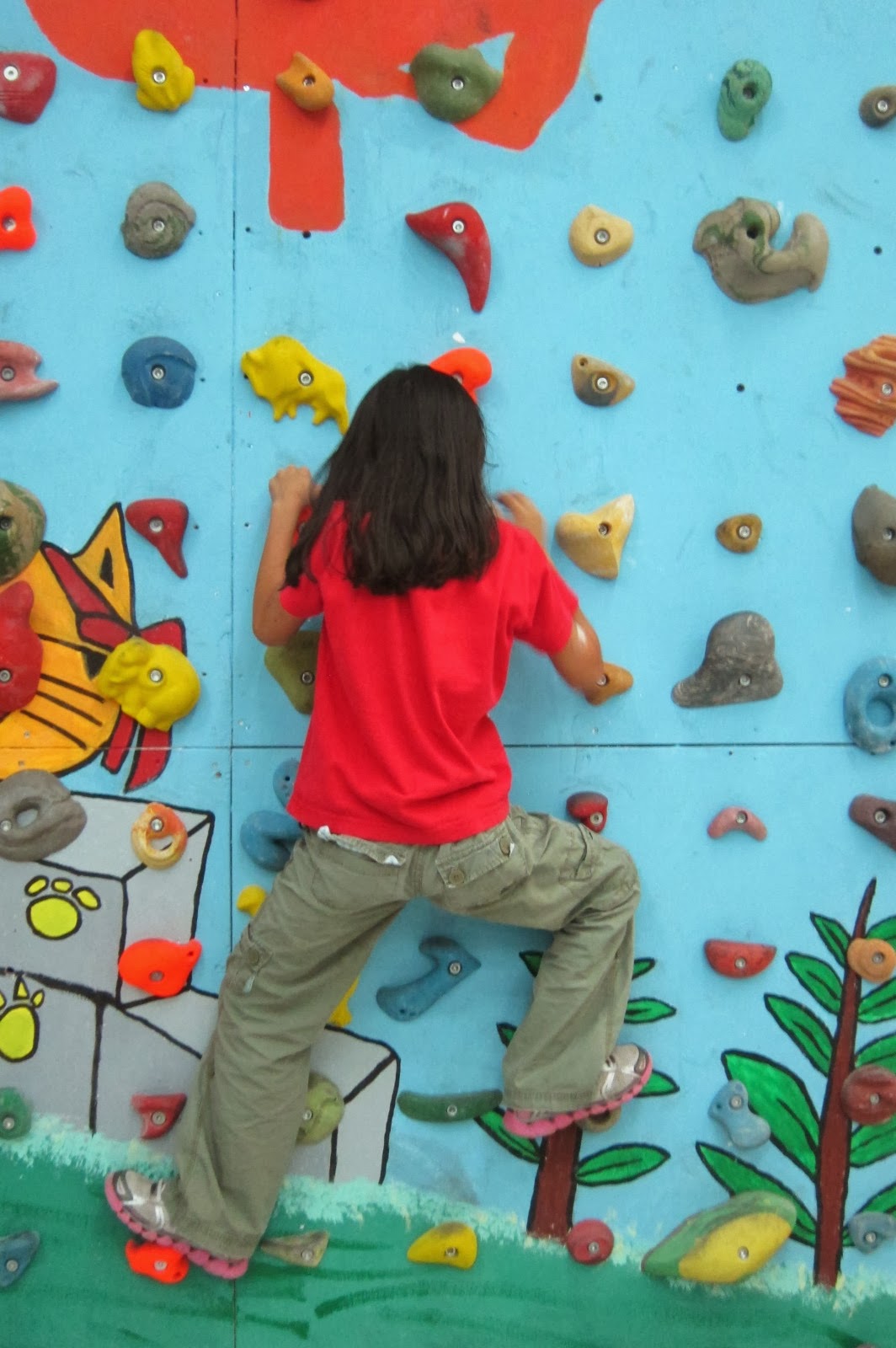
How about a climbing wall in the bathroom?

Tuesday, September 17, 2013

10 Rules for Keeping Parents Happy


My own kids soar because of the
fantastic teachers they have had!


1. Take care of their kids.  Make sure they know that their children are your top priority while you are at school.  And mean it.  They should be.

2. Keep in touch with them.  Sending out a weekly email to keep parents updated on the goings-on of your classroom shouldn't be an extra chore: it's just what you do.  It's your job.  Parents deserve to know.

3. Answer their emails.  Pronto.  Even if you can only say, "I'm busy at the moment, but I'll get back to you as soon as I am able," is polite, professional and puts you in their good books.

4. Be a partner with them and respect their choices.  With the child in the middle of the huddle, you're a team.  Make sure they know it.  Make sure their child knows it.

5. Adopt an open-door policy.  I let my parents know that I am always happy to see them, provided we set up a time in advance.  The more open you are to discussion, the less likely they are to come knocking down your door later.

6. Build your relationships now and nurture them throughout the year.  I know many excellent teachers, but they don't build the parent/teacher bond that is essential to giving your students their best year possible, and that actually, in the long run, makes your life easier.  Building trust with parents should be one of your top priorities.

7. Be sure to let parents know when their children do something commendable, even if it's just in a two sentence email.  They appreciate it and so do their kids.

8. Don't try to come off as a know-it-all, but as a partner with them in their child's learning.  Ask parents for their advice on how to best help their child.  Their insights could make YOUR year a lot easier, and will help you differentiate more effectively for each child's individual needs.

9. Be warm and positive.  Always start your conversations with a smile, a confident handshake and a positive comment about their child.  Sure, you may have to bring up some hard-to-handle issues, but there is ALWAYS something good to say.  That's what you lead off with and that's what you end with.  Always.

10. Don't try to hide things from parents.  If something "goes down," let them know.  If you need to apologise, do so.  If you messed up, own up.  Parents respect teachers who aren't perfect: more than anything, they want teachers who care.

And we do, right?  Why else would we be in this medium-paying gig if we didn't care as much as we do?