Wednesday, September 25, 2013

Noisy Children: What's a Teacher to Do?


I don't know how I ever ended up becoming a teacher and how I lasted these nearly 26 years because I have a serious problem with noise.  (And yes, I HAVE been that teacher who has given one warning too many and then had children sit in silence all the way home on the bus from the field trip.)

Speaking from some experience (but not necessarily from a high degree of success), here are my suggestions on the noise-front for those of you who feel my pain yet have no way to combat the rising tension as the noise level in the classroom escalates to new and unexpectedly shrill volumes as it inevitably does.  Every. Single. Day.

1. Practice deep breathing.  I can't stress this one enough.  Since I've started meditation (mediTation not mediCation), I am a much better teacher.  "Oh," I notice to myself, "the students are yelling again."  Then I smile and breathe some more.  Sometimes I breathe very deeply and very heavily.

2.  Buy one of those shop bells that a customer rings when there is no one at the front counter.  I have one on my desk and one at the front of my classroom.  When I need the class to freeze (or shut up), I ring the bell: my own shrill reminder of their own vociferousness.  It quiets things down.  For at least 30 seconds anyway.

3. I occasionally succumb to "feel sorry for me" moments (or even days) where I say, "Ms. Rempel has a really bad headache today so I'm going to ask you to be particularly kind and just whisper.  Then Ms. Rempel won't have to yell at you and then everyone will be happy."  Sometimes it works.  Don't overuse it, though, or it will completely lose its power.

4. Remind your students that you signed on to become a teacher, not a police officer.  Sometimes it's hard for them to tell the difference.  Sometimes it's hard for me to, as well.  If you play police officer for five or 10 minutes, they usually get the picture.  I don't have a uniform or anything, but that might help.

5. Keep a stash of Advil handy.  And earplugs.

6. Don't take it personally.  Unless you're a substitute teacher or particularly unlikable (which I most certainly am not), students aren't being noisy just to annoy you: it's just who they are.  It's their job to be noisy just like it's your job to get them to zip it up. It completes the circle.

7. Ask yourself, "Is it productive noise?"  Let's face it, noise is necessary.  If kids are going to investigate and inquire and learn, they need to talk.  If they're not talking about who they've got a crush on or about the Rudolph-like pimple on your nose, then you may just need to let it go. I find if I'm inquiring with them, I'm not nearly as bothered by the noise.  So get involved (it's your job, after all), and think of it as the sweet sound of learning instead of chaotic anarchy.

I've got nothing else, folks.  Teaching and learning is noisy and messy and completely unpredictable.  Just go with it.  Or get out of the business.  I'm sure there's a cubicle waiting for you somewhere, if you want to find one badly enough.  I think I've already made my decision.


Sunday, September 22, 2013

The 20 Second Rule


"The less energy it takes to kick-start a positive habit, the more likely that habit will stick."

I just finished reading a chapter in The Happiness Advantage by Shawn Accor that confirms my suspicions and my own at-home experimentation: following the path of least resistance can lead to the greatest success.  As I read his story and experimented with my own, I'm now on a quest to see how I can apply this in the classroom.  I'll keep you posted on that, and I'd love to hear your ideas, too!

In the book, Dr. Accor gives the example of trying to create a new habit of practicing his guitar every evening.  He set up an elaborate record keeping system, kept his guitar in the closet not 20 seconds away from his couch where he usually succumbed to the lure of television, and decided to replace his TV watching habit with his previously joyful habit of playing guitar every day.

Guess what?  It was a rip roaring failure!  He played for four days out of the 21 tick boxes he had set up, and went right back to viewing old episodes of Seinfeld.  Now this is a social scientist who studies successful habits and happiness as his career.  What could have gone wrong?

If you haven't guessed it yet, it was the 20 seconds it took Shawn to go to the closet and retrieve his guitar.  In try number two, Shawn got a music stand and set it up in the middle of his living room with his guitar perched on it.  Success?  You bet!  In his words: "What I had done here, essentially, was put the desired behavior on the path of least resistance, so it actually took less energy and effort to pick up and practice the guitar than to avoid it."

Just to add fuel to the habit fire, he did one more thing: he took the batteries out of his remote control and put them in a drawer very close to the couch where he always watched TV.  The time it took him to put the batteries into the remote control (about 20 seconds), greatly reduced his TV watching habit as well.  He just couldn't be bothered.


 A few weeks ago, I started a habit of my own.  I have an old step box from aerobic videos that I used to indulge in and suffer from.  It's been sitting in our bedroom for years, occasionally used for bouts of exercise or for our daughters to have tea parties on.  I noticed how ugly and unused it was and resolved to throw it out, but then I had a better idea.  I put it on top of my scale (effectively hiding that guilt-inducing machine that I haven't stepped on in more than a year) in my bathroom, right beside the bathroom sink.  Since that step box has been living in our bathroom, I have been using it during all of my morning and evening ablutions:  while brushing my teeth, flossing, moisturizing and the like.  And it adds up!  At least twice a day, I step up and down maybe forty or fifty times, and sometimes longer since I'm now more inclined to polish and floss and exfoliate since I know I'm getting in my exercise at the same time!


I figure this easy, incidental exercise will pay big dividends: bigger than a daily weigh-in on the scale that's for sure.  In fact, I was so affirmed by "The 20-Second Rule" that I've just moved a set of eight pound weights beside the toilet.  This is perhaps an image you don't want to entertain, but you get the picture.  Essentially, the en suite bathroom is becoming my new gym!

So, my personal victory is underway, but next I want to figure out how to translate it into success with my students at school.  I want to make it easier for them to reach their goals, and it seems a few little time-saving tweaks could help them maximise their efficiency and increase their output in so many areas.  Trial some ideas in your own classrooms and let me know how it goes.  Meantime, I'll see what I can come up with and keep you posted!

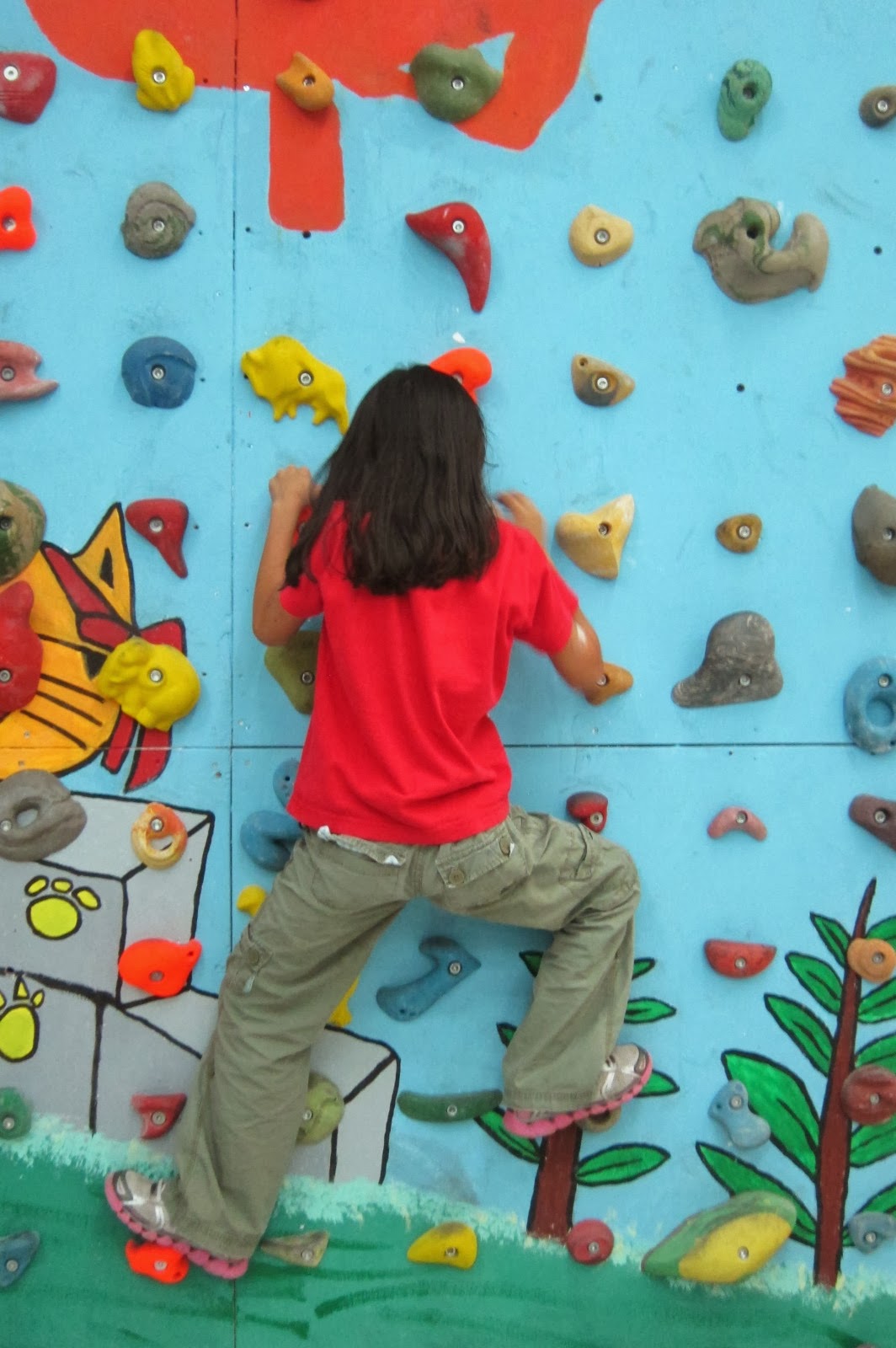
How about a climbing wall in the bathroom?

Tuesday, September 17, 2013

10 Rules for Keeping Parents Happy


My own kids soar because of the
fantastic teachers they have had!


1. Take care of their kids.  Make sure they know that their children are your top priority while you are at school.  And mean it.  They should be.

2. Keep in touch with them.  Sending out a weekly email to keep parents updated on the goings-on of your classroom shouldn't be an extra chore: it's just what you do.  It's your job.  Parents deserve to know.

3. Answer their emails.  Pronto.  Even if you can only say, "I'm busy at the moment, but I'll get back to you as soon as I am able," is polite, professional and puts you in their good books.

4. Be a partner with them and respect their choices.  With the child in the middle of the huddle, you're a team.  Make sure they know it.  Make sure their child knows it.

5. Adopt an open-door policy.  I let my parents know that I am always happy to see them, provided we set up a time in advance.  The more open you are to discussion, the less likely they are to come knocking down your door later.

6. Build your relationships now and nurture them throughout the year.  I know many excellent teachers, but they don't build the parent/teacher bond that is essential to giving your students their best year possible, and that actually, in the long run, makes your life easier.  Building trust with parents should be one of your top priorities.

7. Be sure to let parents know when their children do something commendable, even if it's just in a two sentence email.  They appreciate it and so do their kids.

8. Don't try to come off as a know-it-all, but as a partner with them in their child's learning.  Ask parents for their advice on how to best help their child.  Their insights could make YOUR year a lot easier, and will help you differentiate more effectively for each child's individual needs.

9. Be warm and positive.  Always start your conversations with a smile, a confident handshake and a positive comment about their child.  Sure, you may have to bring up some hard-to-handle issues, but there is ALWAYS something good to say.  That's what you lead off with and that's what you end with.  Always.

10. Don't try to hide things from parents.  If something "goes down," let them know.  If you need to apologise, do so.  If you messed up, own up.  Parents respect teachers who aren't perfect: more than anything, they want teachers who care.

And we do, right?  Why else would we be in this medium-paying gig if we didn't care as much as we do?

Monday, September 9, 2013

Making Thinking Visible While Measuring Angles


Warning: Unless you are familiar with both "Making Thinking Visible" and an inquiry-based teaching approach, you may not find this particular blog useful.  If you are, please read, comment and add your suggestions!  I don't profess to be an expert by any measure or degree.  (I'm making a funny...)


I will soon be starting an inquiry into angles in mathematics, which fits well with How the World Works and our primary six/grade five study of structures.

After taking the "Making Thinking Visible" online course offered through Harvard as a staff last year (google it to find all the thinking routines/take the course to dramatically improve your teaching and your CV!), it has become clear to us all how well the thinking routines fit in with our inquiry model in a PYP school.  Last year, I used them extensively within my transdisciplinary themes, but this year I'm getting more comfortable using them in stand-alone mathematics planners.

The conceptual understanding I want students to arrive at is: Angles can be measured and constructed for a variety of purposes.

In order to do this, students are going to start by doing a THINK/PUZZLE/EXPLORE routine.  This can be used as a mini assessment.


Students will make obviously connections that go beyond geometry.  Angles are a very important concept in geometry though they are not often thought about in our daily lives. However, angles impact our lives in more ways than we think. Students will begin to understand that we all use angles without even realizing.

We will do a THINK/PAIR/SHARE with the following questions:
1.              How do people in various professions use angles to complete their work?
2.              How do all people use angles in their everyday lives?
3.       How do you use angles?

After time spent walking around the school in pairs and identifying angles, then coming together to list them, students will get an “Angle Facts Worksheet” in which they will have to draw the examples they found. 

Students will also undertake a “building a house” activity that promotes understanding of angles; students will do the CREATIVE HUNT thinking routine with the word TRIANGLE, identifying its parts and purposes (How does it work?); the main purpose (What is it for?); and the audience (Who is it for?).  Students will make a ‘target diagram to explore this idea.

After ample inquiry time, students will watch two khanacademy.org videos on identifying and measuring angles.  After they complete their viewing, they will do the CONNECT/EXTEND/CHALLENGE routine.

Students will then engage in some Mathletics exploration and problem solving to do with angles and finally do a HEADLINE routine to summarize their overall understanding of the importance of angles.  This will serve as a good summative overview.


 Reflections on planning a mini-inquiry using the thinking routines:

By using the “backwards by design” planning model in addition to incorporating the visible thinking routines in my mini-inquiry into angles, I feel really empowered about how I can teach students to think and explore through mathematics without using direct instruction at the outset.  Though it wasn’t my intention, I find it interesting that I used three UNDERSTANDING ROUTINES (Connect/Extend/Challenge, Think/Pair/Share, and Headlines) while planning an inquiry into angles.  It makes sense in that this is a rather straightforward concept, but can be taught/learned with a depth that I haven’t explored before as a learner or as a facilitator.

The fact that I plan to use a CREATIVITY ROUTINE (Creative Hunt) will also be an interesting trial: I'm hoping it will allow us to see that you can go beyond basic facts in geometry and see things from different angles.  (Pardon the pun!)  I like the idea of extending student thinking beyond the factual and exploring the creativity and play behind things, even when dealing with empirical, proven information.

I'm so thankful that I am learning how to be playful in mathematics, and teaching my students to be the same.  The best part?  They're learning more deeply through their exploration and play, and they're having fun.  You can't argue with that combination, can you?

Monday, September 2, 2013

The Happiness Component to Learning


Today's blog isn't one about how to facilitate learning so all students will learn in a way that suits them and is appropriately differentiated.  We'll leave that for another day.  Besides, for anyone bothering to read a teaching blog about inquiry, there are resources up the ying yang at your fingertips.

Today's blog is simply about remembering to keep it fun.   It's the beginning of the year for most of us, and that means right now we have the opportunity to set the tone for a community of learners that we'll be a part of for the next nine or ten months.

Pretty much everybody learns best when they are having fun.  No, we're not paid to be entertainers, and, no, every lesson doesn't need to be a barrel of laughs, but the day can be planned in such a way that levity, joy and pleasure are an important component of it.  This includes your delivery and facilitation of lessons as well as all the moments in the day where we have the opportunity to help students feel positive and happy to be at school.


In The Happiness Advantage by Shawn Achor, he writes:

"We become more successful when we are happier and more positive.  For example, doctors put in a positive mood before making a diagnosis show almost three times more intelligence and creativity than doctors in a neutral state, and they make accurate diagnoses 19 percent faster.  Optimistic salespeople outsell their pessimistic counterparts by 56 percent.  Students primed to feel happy before taking math achievement tests far outperform their neutral peers.  It turns out that our brains are literally hardwired to perform at their best not when they are negative or even neutral, but when they are positive."

Isn't it great news that we can improve student assessment simply by helping them get in a resourceful, happy state?  I love this research!  What are some ways in which to do this that take place in the day-to-day workings of a classroom?  Here's a few ideas just to get you started, but I'm sure you can come up with a bucket load of your own.

  • Compliment your students.  When you notice them doing something kind or on-task or things that are part of the Learner Profile or Attitudes, be sure to take a few seconds to honor them publicly.
  • Pull students aside privately on a regular basis for quick one-on-one pep talks where you let them know how much potential you think they have, and how impressed you are with particular aspects of their performance or abilities or personalities.  
  • Send individual emails to students with short but sweet comments such as, "I really appreciated how willing you were to help out your group during collaborative problem solving today.  Way to go!"  It only takes a minute of your time, but the delight and ensuing motivation of such comments (not to mention the parent appreciation) long outweigh the "trouble" it takes to write a few a day.
  • Tell a joke a day (or five or six).
  • Share inspirational quotes.  Sometimes I use quotes (with deliberate mistakes) for my DOL (Daily Oral Language) practice so students can get a dose of inspiration while figuring out the structure and use of language.
  • Allow for laughable moments.  If someone says or does something funny, join in.  Show them you like to have fun too.  
  • Put up a daily cartoon for students to read when they come in to class.
  • Tell funny stories about yourself when you were their age.  Students always love to hear about their teachers' follies and mistakes!
  • Inquiry based learning encourages game playing.  Make sure your learning areas are full of games that are fun and help students meet your set objectives.
  • Have fun with your colleagues. That joy will be translated to your students.


When push comes to shove, we all have to go to school five days a week.  So do our students.  Why don't we all decide to have fun doing it?


Wednesday, August 28, 2013

Strict, Not Mean


I'll never forget the student who came to me near the end of the year and said something to the effect of, "I went around telling everyone that you were mean, but then I learned the right word.  You're strict."

(To my credit she also added that I was fair, and pretty and that she loved me.)

I actually like having the reputation of being a strict teacher, so long as nobody thinks I am cruel or unfair.  A better way of saying it these days is that I have high expectations for all of my students.  (And for myself.)

When we hold students to high expectations both behaviorally and academically, they tend to meet them.  In the essential agreements our class wrote together this year, the students actually talked about how they wanted to hold themselves accountable for their thinking, their work and their behavior. I felt so proud of both them and the stellar school I teach at that has taught them to expect the best of themselves and others!

Students (at least in primary school), often come up to their teachers with their work and say,"Is this good enough?"

My response is always, "I don't know.  Is it?"

The answer is often a sheepish look and a mumble of, "I guess I could __________."

By and large, students know what to do to improve the quality of their work, though they may not know HOW to do it.  That's where we teachers come in: those one-on-one moments, the mini-lessons, the guided reading sessions, the impromptu "Hey, I noticed _______: do you mind if we take a few minutes together to figure that out?" are some of the most powerful learning moments for students and forge some of the most trusting relationships where students know they're not going to be labelled as dumb, but they're going to be accepted for where they're at, and helped to advance a bit further.

I hope the fact that I take the time to share and chat and demonstrate and sit down on the carpet and read with a kid even though my back really hurts mitigates my reputation for strictness.  Also, laughing long and hard about twenty times a day, telling really great stories and listening to their sometimes really boring stories with genuine enthusiasm probably helps.

I'm not too worried about being mean.  And, anyway, aren't you supposed to start off the school year being really mean?

Does this look like a teacher students are afraid of?


Sunday, August 25, 2013

Some Great Inquiry Resources

School has started and my professional reading has been kick-started after a summer of beach reads and fluffy magazines.  (Okay, I always read fluffy magazines!)

These are some of the books that I've been delving into lately or have been referring back to.  Good chance they are in your school's professional library.  Have you looked through it lately?  If they're not there, they are worth making your own personal investment in!


About Teaching Mathematics: A K-8 Resource by Marilyn Burns.  This is a comprehensive text that helps teachers teach math in a way that builds understanding and skills, with a focus on inquiry-based, often open-ended problem solving.  

Classsroom Connections: Strategies for Integrated Learning by Kath Murdoch.  In her own words, "The best topics are built around big ideas that engage students in learning about significant, robust and transferable ideas."  This books is chock-full of strategies to help your students do exactly that!  It's one of my all-time favorites...

Understanding by Design  by Grant Wiggins and Jay McTighe  This is a resource to help YOU help kids dig deeper into their projects through thoughtful planning. It's indispensable if you're committed to an inquiry-based learning environment! 

How to Differentiate Instruction in Mixed-Ability Classrooms by Carol Ann Tomlinson.  Differentiation isn't only a buzz-word, it's a must-do.  This is a no-nonsense guide on how to really think, plan and actualize differentiation across the curriculum in your classroom.

Engaging Readers and Writers with Inquiry by Jeffrey D. Wilhelm.  This was recommended to me by a teaching colleague, though I haven't read it yet.  I'm excited to get to it!  It seems like it will fit right into "Making Thinking Visible" routines we already use at our school, and, of course, our PYP curriculum.

My kids giving an example of why
inquiry and critical thinking are
so important!

Happy reading!  Remember: even five minutes a day of professional reading is going to improve your teaching practice.